Figure 1
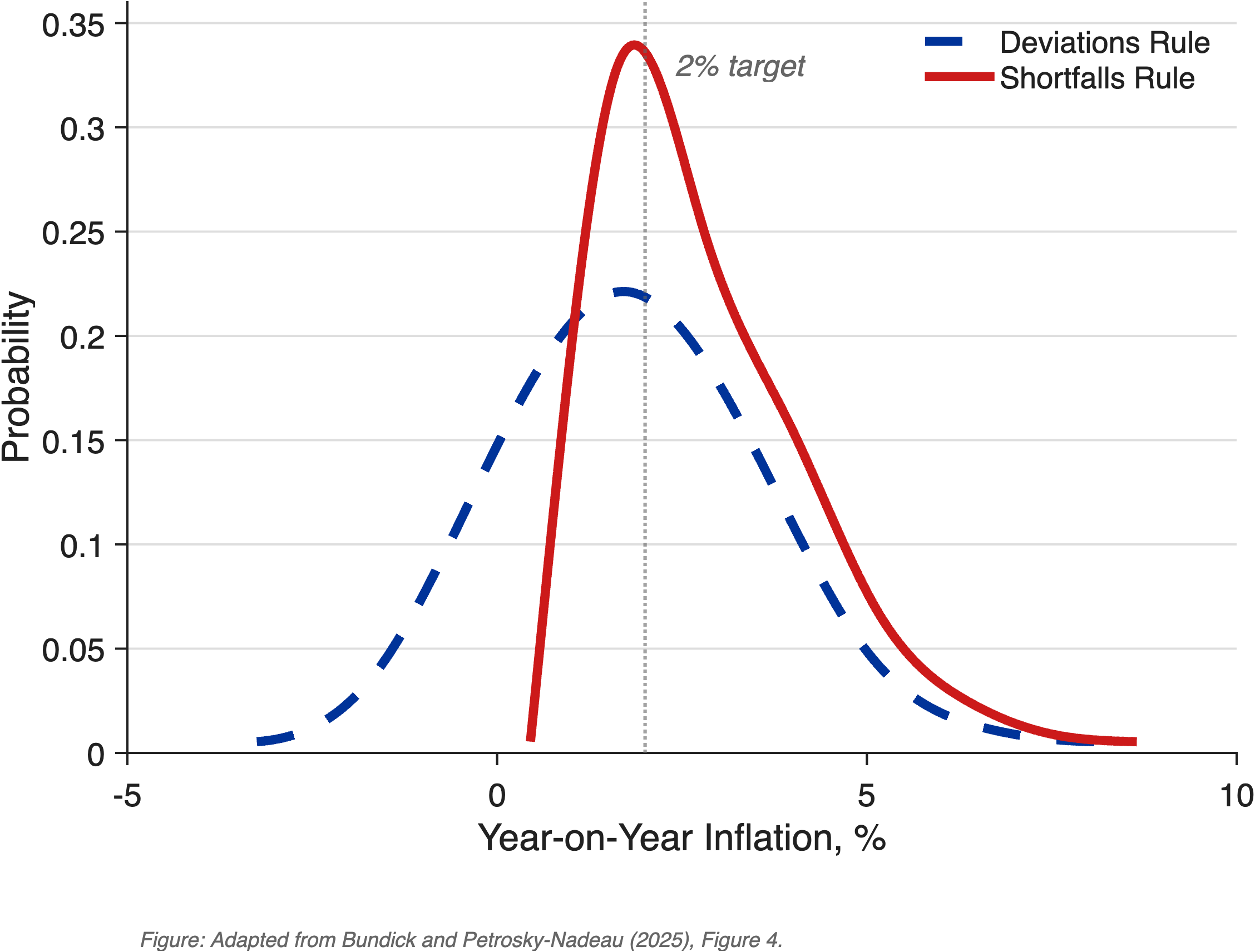
In August 2020, the Federal Reserve revised its Statement on Longer-Run Goals and Monetary Policy Strategy. One change stood out in how the Fed described its employment mandate. The previous framework guided monetary policy to respond to “deviations” of employment from its maximum level—tightening when the labor market ran hot, easing when it ran cold. The revised framework narrowed this to “shortfalls,” leading policy to respond only when employment fell below its maximum. In other words, a tight labor market would no longer, on its own, trigger a policy response.
The Question
What are the consequences of this asymmetry? Does removing the response to above-maximum employment come at a cost?
In Bundick and Petrosky-Nadeau (2025) we explore this question using a New Keynesian model with labor market frictions—hiring costs, separations, and a matching process for workers and firms—alongside a zero lower bound (ZLB) on interest rates. The key mechanism is straightforward: by not responding to above-maximum employment, the shortfalls rule removes one channel through which monetary policy anchors inflation expectations.
What the Model Finds
Under the shortfalls rule, average inflation in the calibrated model rises by approximately 90 basis points relative to the symmetric deviations rule. The figure illustrates this shift. The solid blue line shows the distribution of year-on-year inflation under the deviations rule, which spreads widely and evenly, extending into deflationary territory. By contrast, the dashed red line shows the shortfalls rule shifting the distribution of inflation outcomes toward higher rates on average, and significantly reducing episodes of inflation below the 2% target.
This is not simply a level shift. Because the central bank no longer tightens in response to an overheating labor market, demand-driven expansions generate higher inflation than under the symmetric rule. The asymmetry in the policy rule produces an asymmetry in inflation outcomes.
When the Bias Can Be Beneficial
The higher average inflation carries an important upside. Under the deviations rule, the economy reaches the ZLB—where the central bank can no longer reduce rates—approximately 26% of the time. Under the shortfalls rule, that frequency drops to less than 1%. In other words, the inflation bias acts as insurance in that higher average inflation keeps interest rates elevated enough that the central bank retains room to cut in downturns.