Figure 1
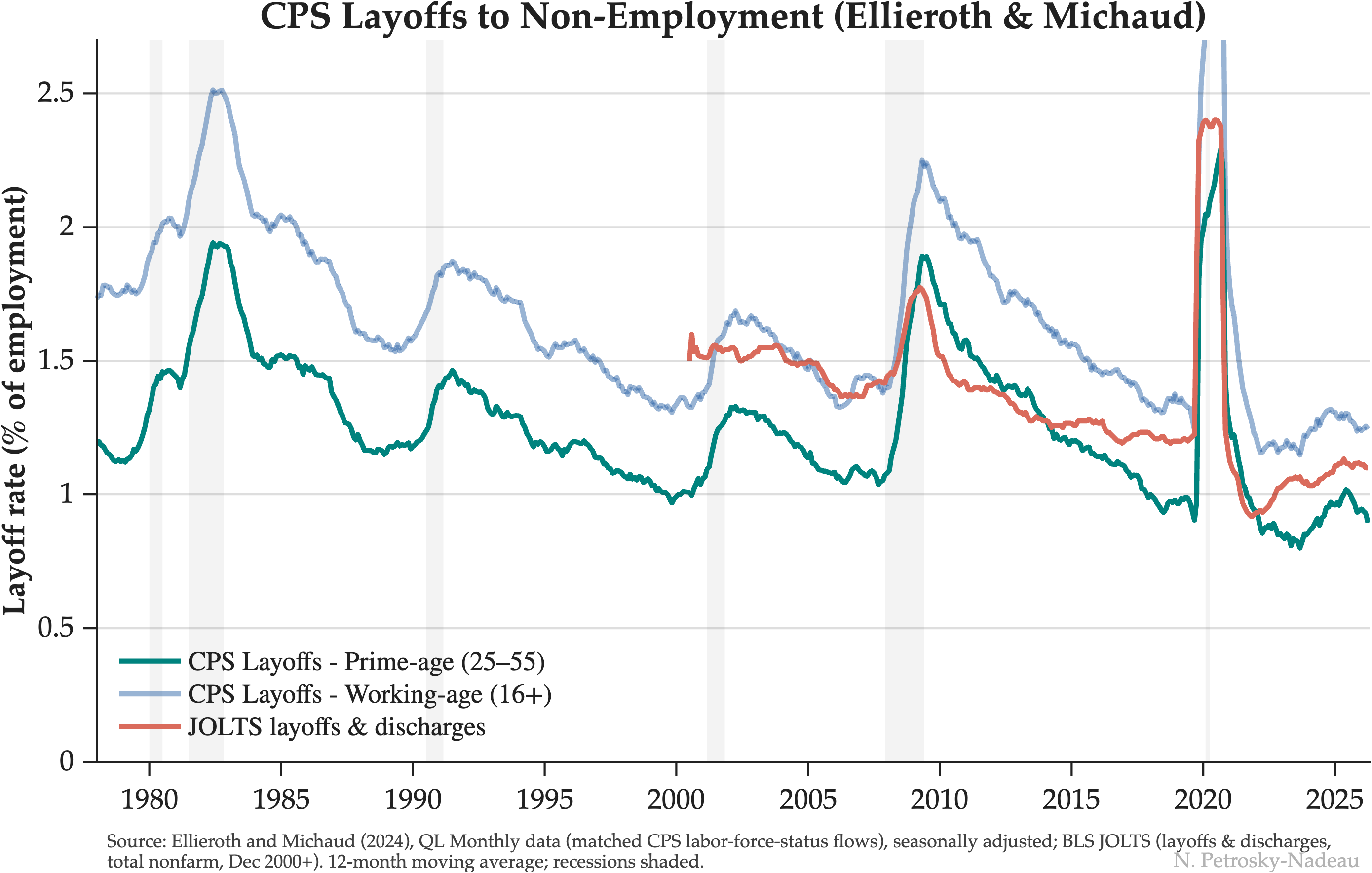
Commentators increasingly describe the current U.S. labor market as a “low-hire, low-fire” environment: firms are reluctant to add workers but equally reluctant to let them go. The low-fire half of that description rests largely on the Job Openings and Labor Turnover Survey (JOLTS), where the layoffs and discharges rate has held near record lows. JOLTS, however, began only in December 2000. It spans just two recessions, too few to judge whether today's low layoff rate is genuinely unusual or simply what a strong labor market looks like.
Research by Kathrin Ellieroth and Amanda Michaud offers a way to extend the view (Ellieroth and Michaud, 2024). The authors build a monthly series of layoffs from the Bureau of Labor Statistics (BLS) Current Population Survey (CPS), the household survey, by linking individuals across consecutive months and classifying each job separation by its stated reason. Their series, which they update and publish monthly, reaches back to 1978 and covers six recessions. Because it draws on the household survey, it can also be broken out by worker characteristics in ways JOLTS cannot, such as by age. The Figure plots the CPS layoff rate for all workers age 16 and older (blue line) and for prime-age workers, those 25 to 54 (teal line), alongside the JOLTS layoffs and discharges rate where it is available (salmon line). All series rise sharply in every recession and recede in each expansion.
Taking the long view, the layoff rate shows little trend, or at most a mild one, over nearly five decades once the aging of the workforce is taken into account. That is, the mild downward trend in the overall layoff rate may be related to the changing age composition of the workforce: focusing on the core of the workforce, people aged 25 to 54 years old, removes most of the downward trend. The prime-age layoff rate troughs at around 1% in each of the expansions in the sample. This perspective isn’t evident when considering the JOLTS layoff rate alone.
Why it matters: This longer perspective, together with accounting for the aging of the workforce, reframes the low-fire narrative. A low layoff rate, particularly among prime-age workers, is not a recent departure but a recurring feature of late-expansion labor markets. The current level, though a touch low, is not out of line with what prior strong economies produced. The value of the Ellieroth and Michaud series is that it lets us see this regularity at all. Seen beside the CPS measure, the JOLTS record covers only the most recent stretch of an otherwise stable history. As such, the low layoff rate of today looks less puzzling. Whether this persists will depend on the path of the broader economy.