Figure 1
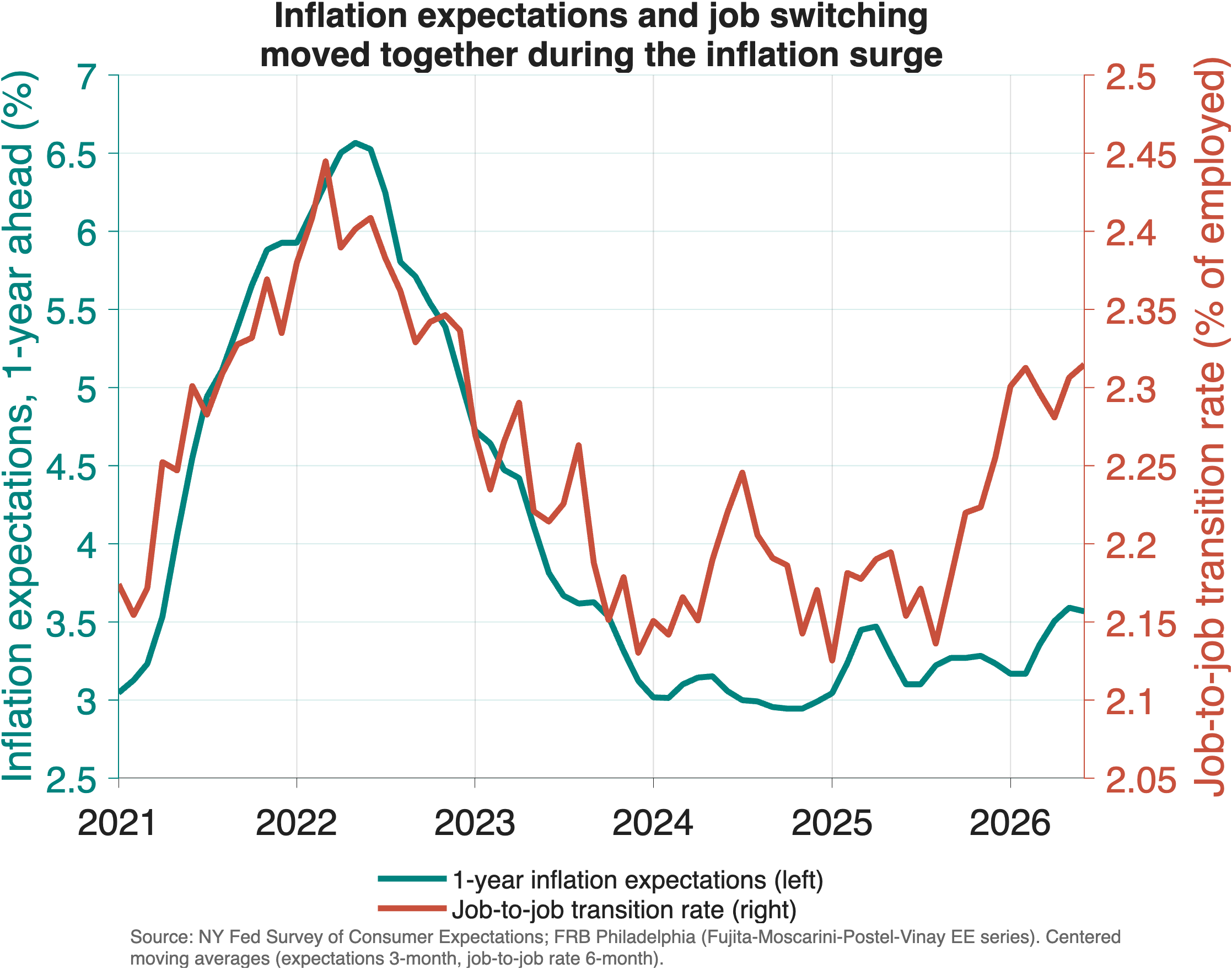
During 2021 and 2022, workers changed jobs at an unusually rapid pace. A recent paper points to a basic force behind it: workers were trying to keep up with inflation.
The question. Most wages are set in nominal terms, fixed in dollars and adjusted only now and then. When prices rise, the real value of a paycheck erodes between raises. Does the expectation of that erosion push workers to look for a new job?
What the authors find. Laura Pilossoph and Jane Ryngaert (2026) find that it does. Combining a survey experiment with the New York Fed’s Survey of Consumer Expectations (SCE), they find that a 1 percentage point increase in expected inflation raises the chance a worker searches for new work by about 0.7 percentage point. Applied to the post-pandemic rise in expectations, that response can account for roughly 40% of the increase in job-to-job transitions through mid-2022.
The Figure shows the two series the mechanism connects. One-year inflation expectations (teal line, left axis) and the job-to-job transition rate (red line, right axis) climbed together through 2021 and peaked within a few months of each other in the first half of 2022, expectations near 6.6% and job switching near 2.45% of the employed. In other words, expectations and job changes rose and fell as a pair through the inflation episode.
Why it matters. Changing jobs is one of the main ways workers secure raises. If inflation expectations drive search, and search drives job changes, then inflation can feed back into wages through the labor market itself, worker by worker.
The picture in 2026. The mechanism fit the 2021–24 episode closely. Since mid-2025 both series have turned up again, with expectations rising from about 3.0% to 3.6% and the job-to-job rate from 2.14% to 2.32%. Yet one piece is missing this time. Wage growth has not picked up alongside the renewed job switching. Whether that reflects a labor market that gives workers less leverage, or simply a lag before the pressure shows through, is not yet clear. The authors’ results suggest it is worth watching.