The Atlanta Fed’s Wage Growth Tracker counts many workers as job switchers only because an occupation or industry code changed, and those codes are often noise. Going back to the survey microdata, I keep only workers aged 25 to 54 who reported a new employer or changed both occupation and industry.
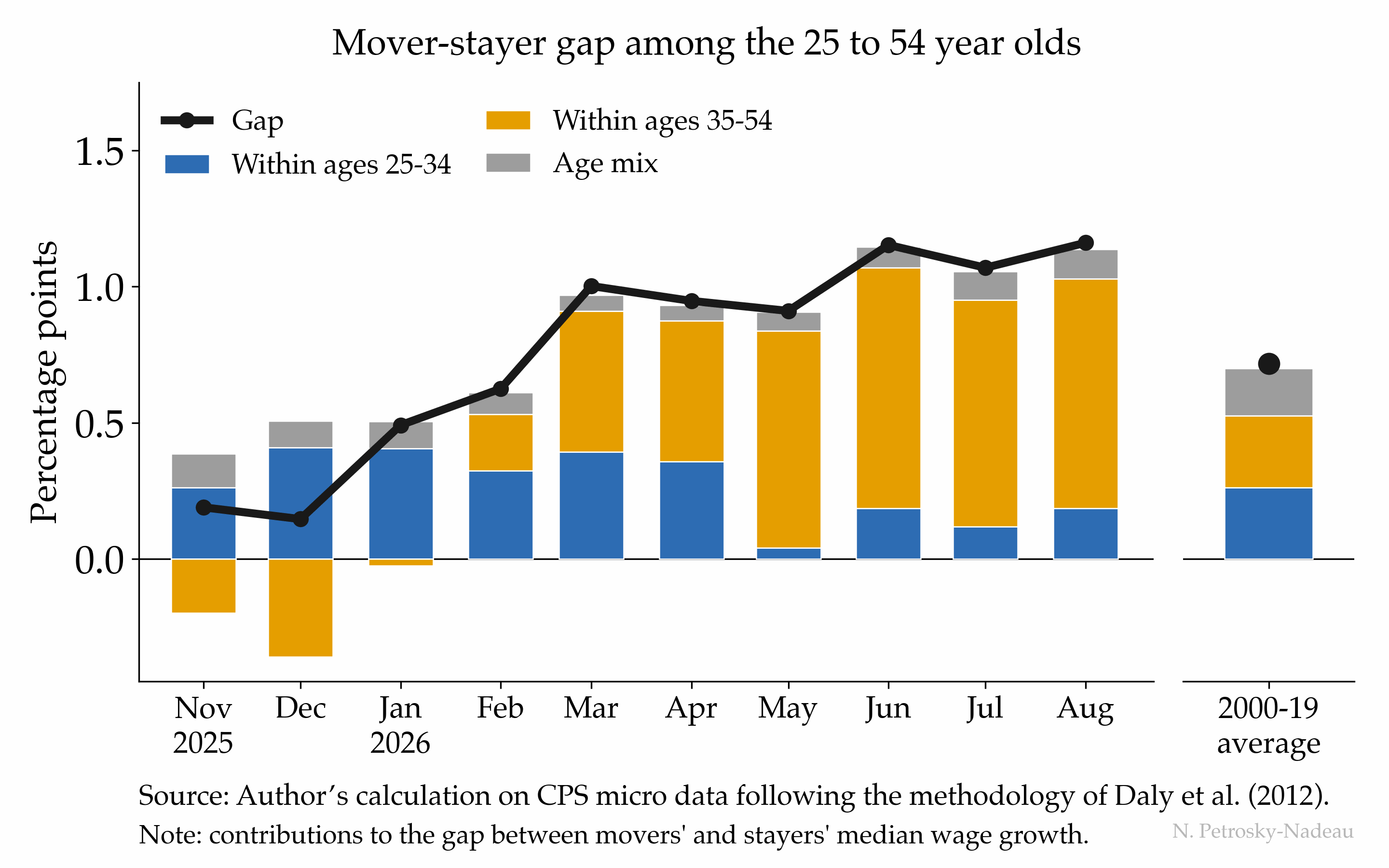
For these movers, median wage growth slid from 7.3% in early 2024 to 4.2% at the end of 2025, then climbed back to 5.0% while stayers slowed to 3.9%: a 1.2-point gap, against a 2000–2019 average of 0.7.
In that 2000–2019 average (the bar on the right), the gap came about equally from movers 25 to 34 (blue) and 35 to 54 (orange). Today movers 35 to 54 contribute more than four times as much as the younger group, roughly three quarters of the gap, while the younger movers’ share is a little below its norm. The samples are small, about 1,400 prime-age movers a year, so read the split as a direction rather than a measurement.