People in their twenties have long moved from outside the labor market into a job more frequently than workers in mid-career. That is changing, and the gap is the narrowest in three decades of data.
Job finding, ages 21–30 relative to ages 35–54
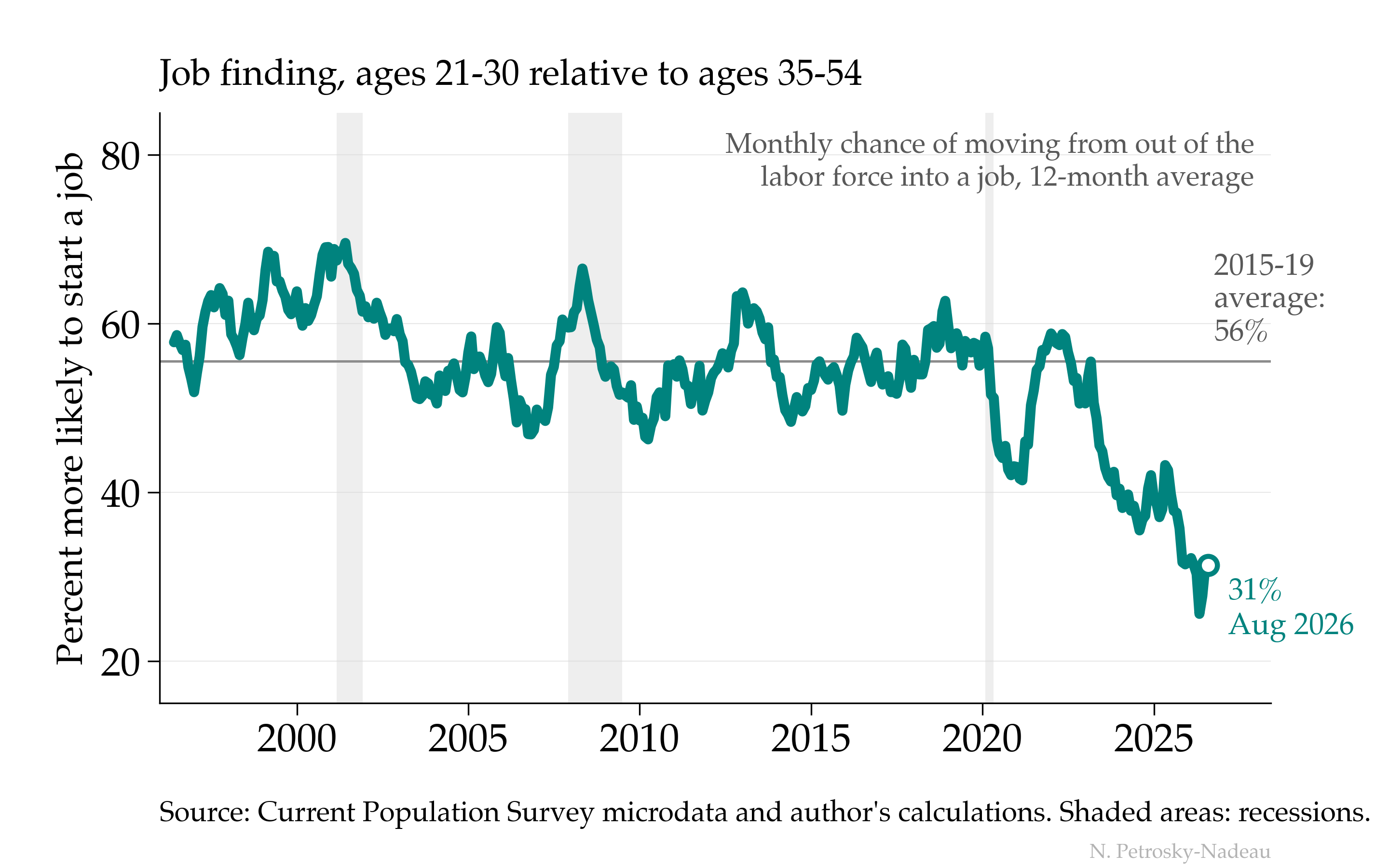
Percent more likely to start a job: the monthly chance of moving from out of the labor force into a job, 12-month average, ages 21 to 30 relative to ages 35 to 54. Gray line: 2015–2019 average. Shaded areas: recessions. Source: Current Population Survey microdata and author’s calculations.
Hover or tap for values.
The teal line follows people out of the labor force (neither working nor looking, as many students and new graduates are) and their chance of starting a job in a given month. In 2022, as before the pandemic, a 21-to-30-year-old in that position was about 56% more likely to make the move than a 35-to-54-year-old. By August 2026 the difference was down to 31%, as young adults’ monthly rate slipped from about 12% to 10% while experienced workers’ remained unchanged.
This is one more signal that the first step into a career has become harder.